



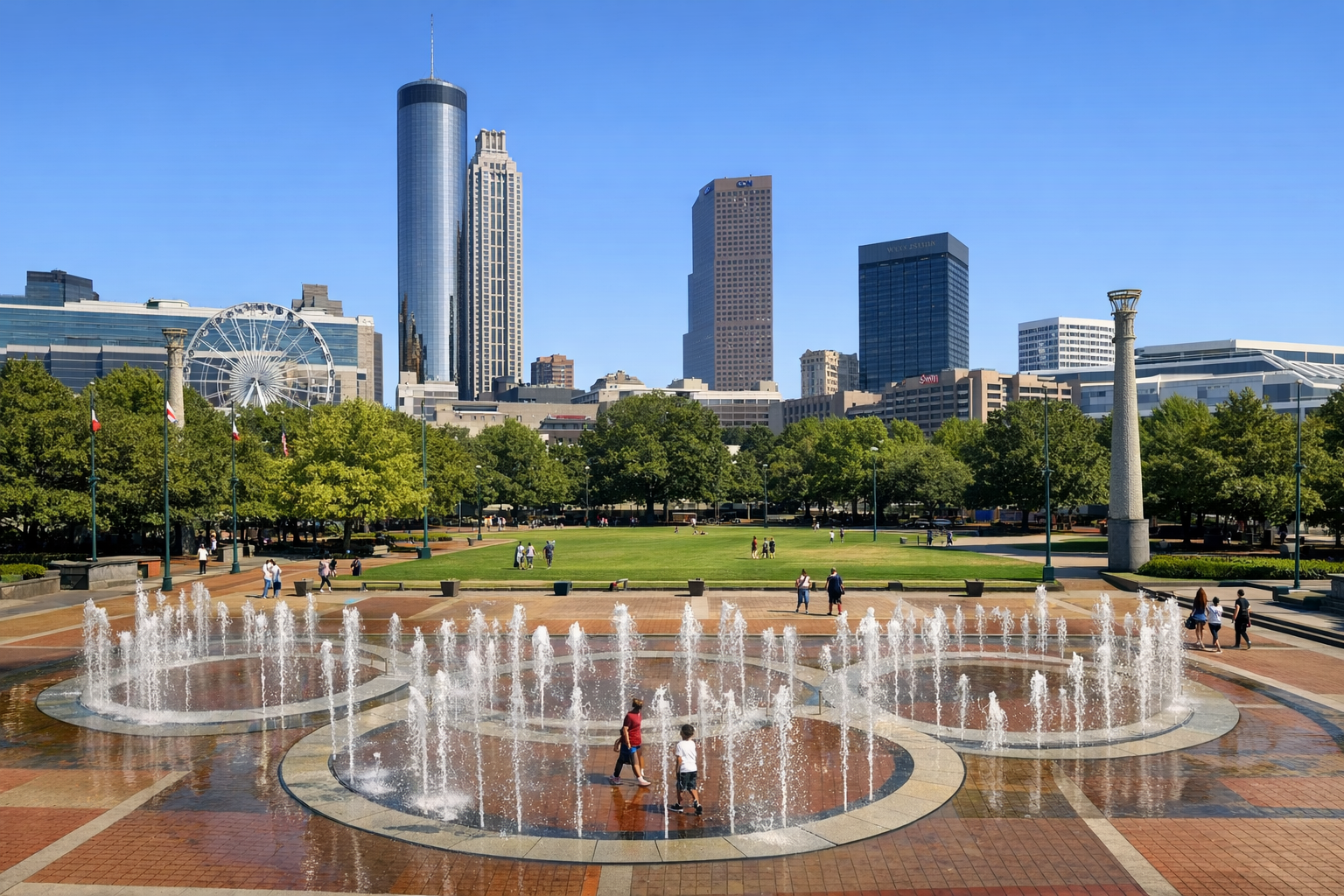
Built as a legacy gathering place from Atlanta’s Olympic era, Centennial Olympic Park now helps stitch together museums, hotels, and event spaces in the center of Downtown, with the Fountain of Rings marking the park’s everyday rhythm.
Centennial Olympic Park is a Downtown Atlanta space that works like a civic clearing: open, central, and easy to reach from the city’s main visitor corridor. It began as part of Atlanta’s Olympic legacy, but its daily role is simpler and more local. People cross it on the way to museums, pause by the Fountain of Rings, meet friends before events, or use it as a calm link between nearby attractions. The park shows how Atlanta turns big moments into public space that still feels useful afterward.
Fast facts
- It is one of Downtown Atlanta’s signature public spaces. Centennial Olympic Park sits in the city center with the kind of open footprint that gives Downtown room to breathe. For locals and visitors, it functions as a clear landmark in a dense area of streets, towers, and attractions.
- The park was created as a legacy gathering place from Atlanta’s Olympic era. Its purpose was larger than a single event: to leave Atlanta with a place where people could gather long after the games ended. That legacy still shows up in the park’s open lawns, paths, and steady everyday use.
- The Fountain of Rings is one of the park’s most recognizable features. The fountain gives the park a moving center point, drawing attention without overpowering the space around it. Its water, rings, and open viewing area make it a natural stop for families, groups, and anyone moving through Downtown.
- It sits near major attractions including the Georgia Aquarium, World of Coca-Cola, and College Football Hall of Fame. The park is positioned among some of Downtown’s most visited destinations, which makes it part of a compact walking circuit. That placement matters because it lets a visitor move from one attraction to another without losing the sense of place.
- For Downtown visitors, it often works as a walkable anchor between museums, hotels, and event venues. In a district where people arrive for conventions, games, and museum visits, the park helps organize foot traffic. It gives travelers a common meeting point and a place to reset before continuing through the surrounding blocks.
The Atlanta angle
Centennial Olympic Park is easy to understand once you stand in it: it is not just open space, but a connector. Downtown Atlanta has a lot of movement packed into a few blocks, and the park helps that movement feel legible. People use it as a meeting point, a shortcut, a pause between attractions, or a place to wait before the next part of the day. The Fountain of Rings gives the park a focal point, but the real design is in how the space supports walking, gathering, and orienting yourself in the city center. That makes it useful in a way many public spaces are not.
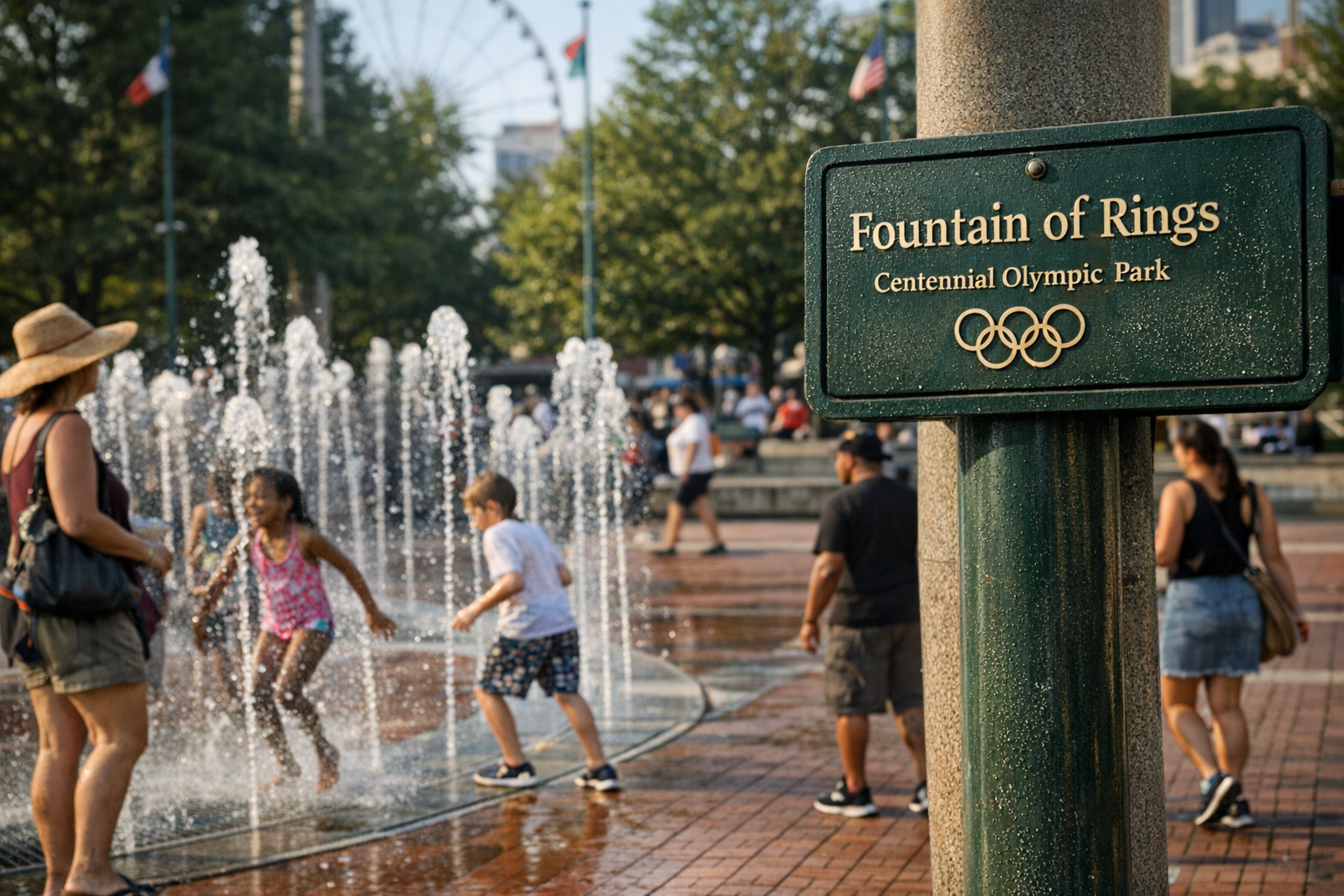
The park also shows a familiar Atlanta pattern: big civic events leave behind spaces that have to work in ordinary life. Here, that means a park that still serves visitors, workers, and eventgoers moving between nearby institutions and hotels. Its location near the Georgia Aquarium, World of Coca-Cola, and College Football Hall of Fame places it inside a dense Downtown route, where a single green space can shape the pace of a whole block. For anyone trying to understand Downtown Atlanta, Centennial Olympic Park is a good place to start, because it reveals how the city organizes foot traffic, public memory, and daily use in the same footprint.
Keeping You In The Know