



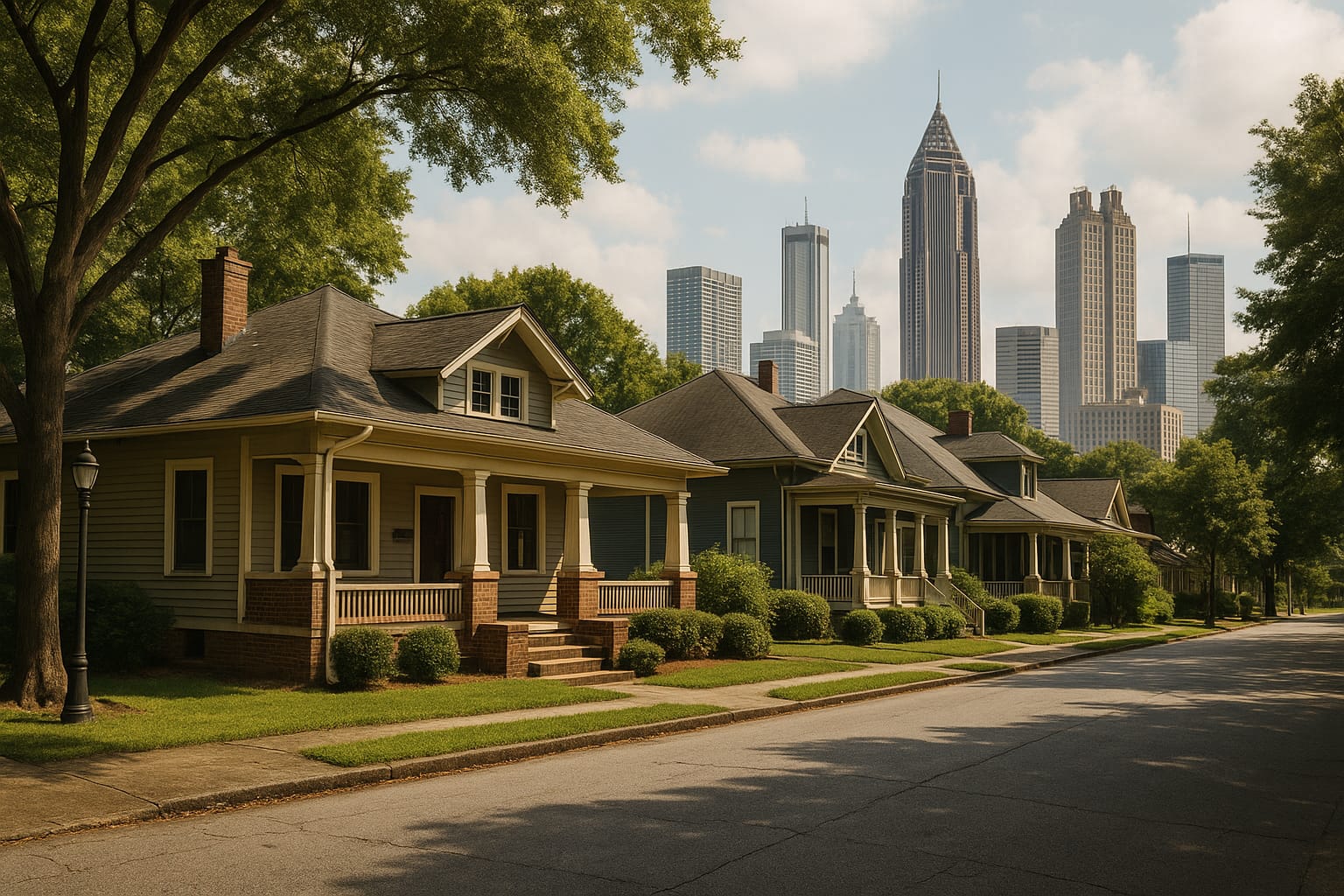
From Victorian porches to Olmsted-influenced roads, some of Atlanta’s oldest neighborhoods still read like a city archive—if you know how to look.
Across Inman Park, Grant Park, and Druid Hills, historic housing is still doing active cultural work. These are not sealed-off showpieces. They are lived-in neighborhoods where architecture carries the story of who built Atlanta, how the city expanded, and what preservation can and cannot hold onto as change keeps coming.
That matters in Atlanta, where redevelopment and reinvention often move fast. Some of the city’s clearest history survives not in a museum case, but on residential streets: Queen Anne ornament, Craftsman porches, Neoclassical symmetry, curving roads, deep setbacks, and old tree canopy. Walk slowly, and the city starts to come into focus.
The house as historical record
Inman Park, recognized as Atlanta’s first planned suburb, remains one of the city’s strongest cases for preservation. Developed in the late 19th century as a streetcar suburb east of downtown, it still carries much of the visual drama that made it desirable: Victorian homes, curving streets, and a residential scale that feels distinct from newer parts of the city. Its restoration story matters, too. By the mid-20th century, many of the neighborhood’s larger houses had been divided or had fallen into disrepair. Residents who took on their repair helped shape an early neighborhood revival story in Atlanta.
The architecture still leads. Turrets, wraparound porches, stained glass, patterned shingles—Inman Park is not subtle, and that is part of its appeal. Just as important, much of it still reads coherently from block to block, offering a sense of continuity Atlanta does not always manage to keep.
Grant Park tells a different story. Named for the city’s oldest public park, the neighborhood mixes late-19th- and early-20th-century houses with a more varied urban history. Its architecture is less uniformly grand, and often more revealing for that reason. Modest cottages sit near larger homes, and the streets suggest a broader social range. The surviving housing stock reflects Atlanta’s growth through rail, industry, and early suburban expansion.
Druid Hills shifts the focus from individual houses to the larger landscape. Developed in part through the influence of Frederick Law Olmsted’s planning ideas, the neighborhood is defined as much by winding roads, deep setbacks, and a park-like feel as by any one architectural style. Colonial Revival, Tudor Revival, Craftsman—the houses vary. The larger composition is what holds the district together. The streets are part of the historic artifact.
Preservation, but lived-in
In Atlanta, preservation is often framed as a fight against demolition. In these neighborhoods, it also looks like something quieter: protecting scale, keeping additions from overwhelming older structures, and holding onto the details that make a street feel rooted instead of interchangeable.
That work tends to fall to neighborhood groups, preservation advocates, and homeowners taking on expensive, slow stewardship. The Atlanta Preservation Center has helped keep public attention on historic buildings and districts across the city, while neighborhood organizations often become the first place residents turn when zoning changes, teardowns, or infill plans start moving.
The tension is familiar. Atlanta needs housing, and historic neighborhoods cannot become static enclaves. At the same time, once a block loses its architectural logic, it rarely gets it back. Tree canopy takes time. Masonry detail is not easily replaced. Neither is a streetscape built for walking, porches, and neighborhood-scale life.
The most persuasive preservation arguments now tend to be less nostalgic than practical. Historic neighborhoods can support forms Atlanta already values: duplexes on older lots, accessory structures, corner retail, housing near parks and transit. At their best, they show that character and urban life do not have to cancel each other out.
Reading the city block by block
These neighborhoods still matter because they make Atlanta easier to read. Inman Park’s Victorians point to late-19th-century wealth and streetcar-era suburban expansion. Grant Park’s mix of house types suggests a wider slice of early urban life. Druid Hills shows the ambition of planned residential design and the status attached to landscape itself.
They also complicate the city’s self-image. Historic beauty can obscure harder histories—segregation, displacement, uneven investment, and the selective way cities decide what is worth saving. Architecture preserves evidence, but not always context. A restored facade is part of the story, not the whole story.
If you want to understand these places with more depth, start on foot. Look at setbacks, rooflines, porch columns, lot patterns, and the points where historic fabric gives way to newer construction. In Atlanta, the city often reveals itself most clearly where eras meet. That is where the next preservation debate is usually already taking shape.
Indakno — Keeping you in the know.