



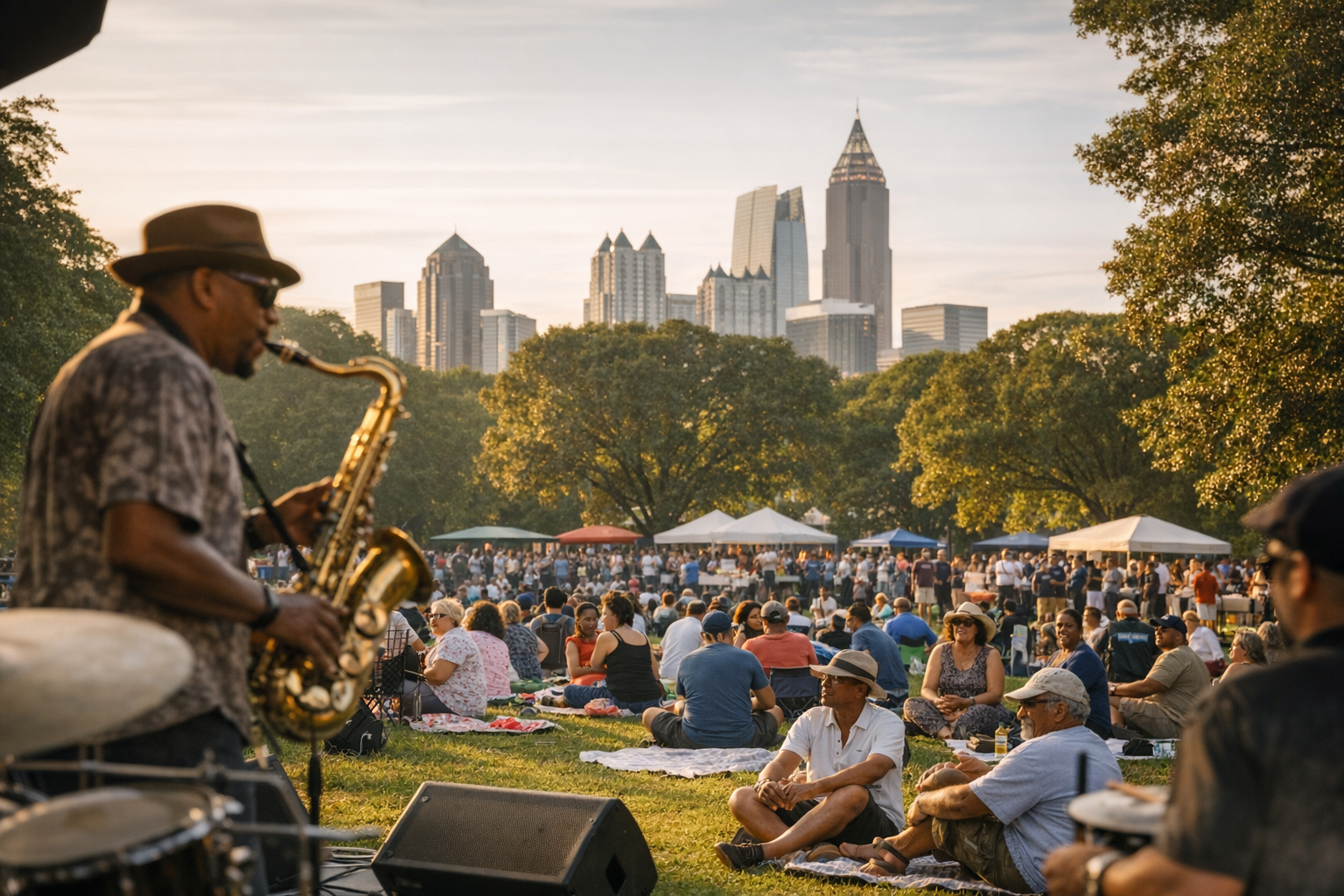
Before the massive soundboards rise over Piedmont Park on Memorial Day weekend, the Atlanta Jazz Festival starts smaller—on neighborhood grass, with folding chairs, coolers, and blankets under old tree canopies.
The Neighborhood Jazz Series sends free weekend concerts across the city, turning local parks into pop-up jazz rooms and reminding Atlanta that this music is a habit, not a once-a-year spectacle.
The know: jazz on neighborhood grass
The Atlanta Jazz Festival runs all month; the Neighborhood Jazz Series is the weekly ritual. Instead of funneling everyone straight to Midtown, the festival drops bands into community parks for free Saturday and Sunday shows ahead of the Piedmont Park finale.
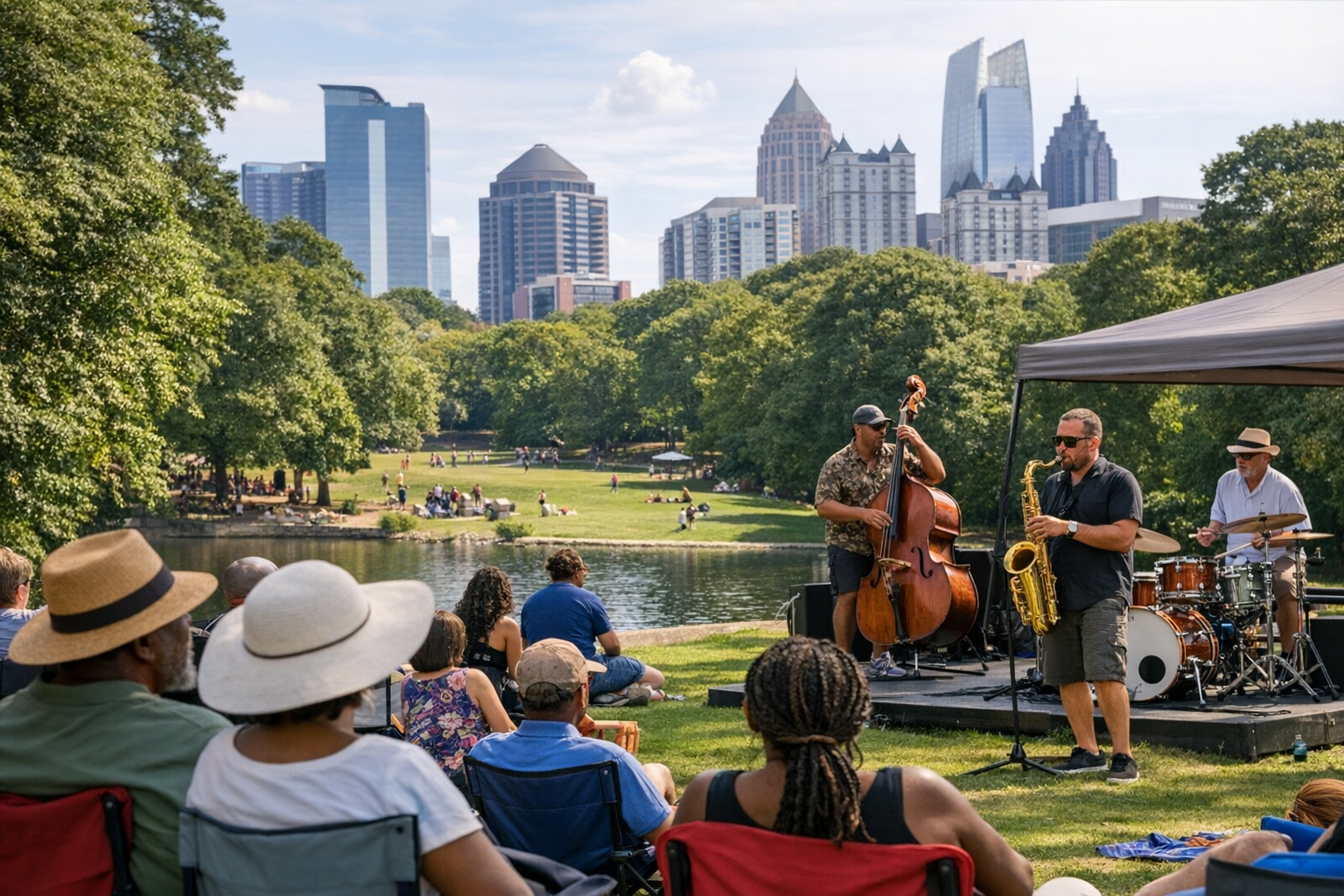
- What it is: Free outdoor jazz concerts in city parks, staged under the festival umbrella and scaled to neighborhood life.
- Where: Rotating parks—often Washington Park on the Westside, parks in West End and Southwest Atlanta, Grant Park, and other City of Atlanta greenspaces.
- When: Weekends leading into the festival’s Memorial Day run at Piedmont Park. Parks, dates, and lineups shift each year; confirm on the official schedule.
- Cost: Free. No tickets or reservations. Bring your own chairs, blankets, and snacks, within park rules.
- Who it’s for: Nearby residents, families, working musicians’ fan bases, and anyone who prefers a lawn chair and open park to a fenced festival crowd.
The series leans on local and regional players—bands you’ll encounter at clubs, churches, and school programs the rest of the year, not just touring names with prime slots at Piedmont Park. The appeal is the low-friction entry into festival season: no gates, no tiers, just a stage on familiar ground.
Street-level festival, city-scale impact
Produced by the City of Atlanta Mayor’s Office of Cultural Affairs, the Atlanta Jazz Festival is a large, free, city-run event anchored by three days in Piedmont Park. The Neighborhood Jazz Series is the walkable version, closer to where people actually live.
A typical park stop stacks an afternoon or evening of music—earlier sets from student ensembles or smaller local groups, then a headliner with enough pull to draw neighbors out with coolers and strollers. One weekend might sit firmly in straight-ahead swing; another might lean Latin jazz, soul-inflected sets, or younger bands treating jazz as a launch pad rather than a boundary.
Production stays modest: mobile bandstands, compact sound, volume scaled to surrounding streets. Brass and drums bounce off pavilions, courts, and houses instead of truss towers. It feels like a neighborhood event, not a touring machine passing through.
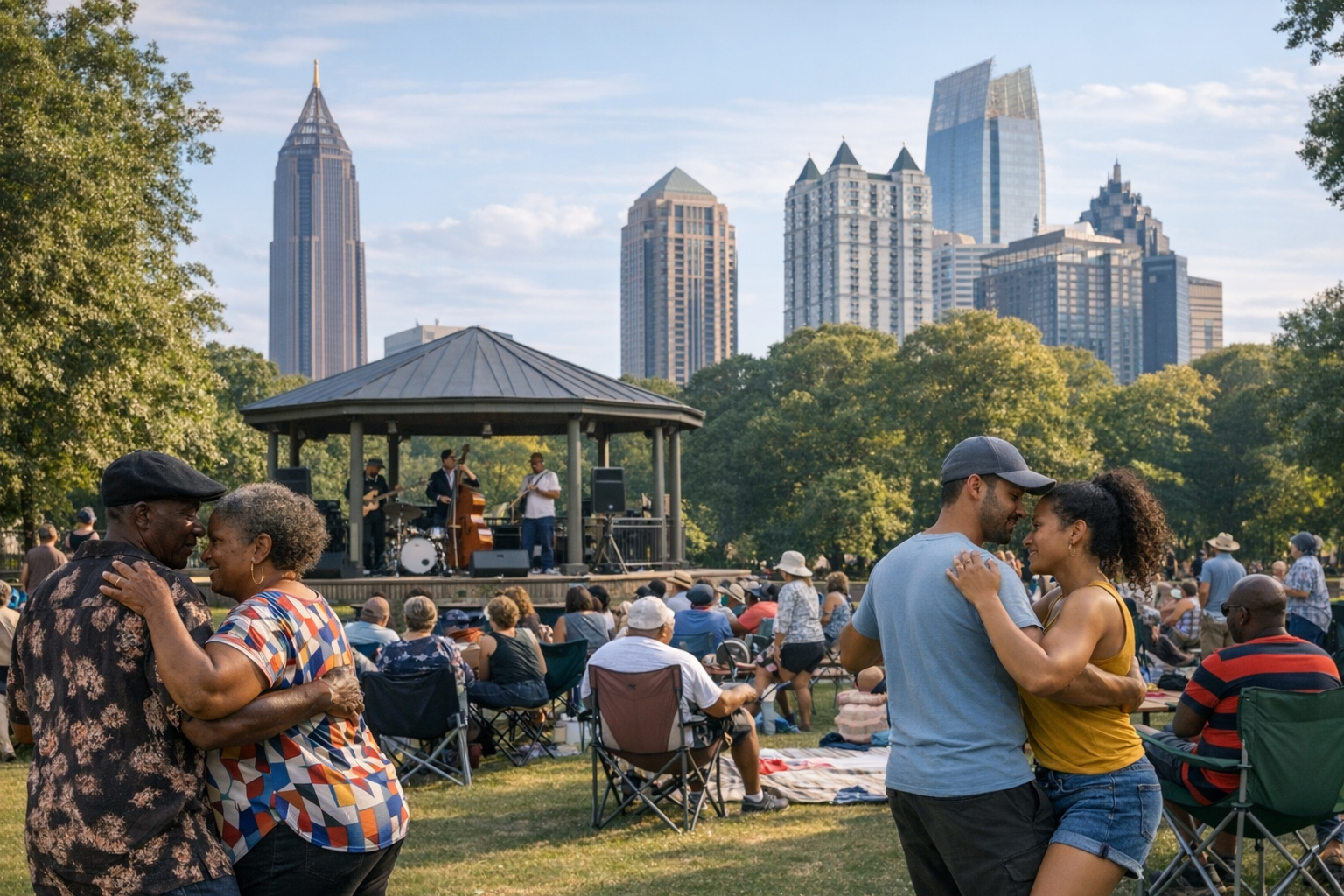
Piedmont Park still hosts the national names and dense crowds. The park shows provide something else: repetition and proximity. When jazz drifts out over the same field that hosts practice drills and cookouts, it registers as part of Atlanta’s everyday soundscape, not a special-occasion import.
Atlanta, mapped in parks
Atlanta is routinely framed as a hip-hop capital, a film backlot, a logistics hub. The Neighborhood Jazz Series makes a different argument in plain view: this is also a jazz city, and that identity is claimed as much on municipal grass as inside the Atlanta History Center or the High Museum of Art.
At Washington Park, an afternoon set lands in a space with deep Black civic history. A stop in Historic West End taps live-music lines that run through neighborhood churches, school auditoriums, and small venues. Southwest parks near Cascade and Campbellton Road draw on long-running traditions of church musicians and school bands feeding Atlanta’s bandstands. Grant Park pulls in BeltLine traffic and families who treat the park as a weekly default, not a destination.
By putting stages into those parks, the festival quietly redraws the city’s arts map. The same team that books national acts for Piedmont Park builds complete shows in places where residents might otherwise drive across town for an equivalent experience. For a few hours, their local park sits in the middle of Atlanta’s jazz conversation, even as cost and distance keep much of the traditional cultural core clustered in Midtown and Buckhead.
The audience follows that geography. A Neighborhood Jazz date might pull kids still in uniforms from earlier games, older neighbors with rolling carts and umbrellas, cyclists peeling off the Atlanta BeltLine, and families who know every corner of the playground. The music folds into existing routines—and the trumpeter you hear at a park set may be the same name you later spot on a club bill or a Piedmont Park stage.
How to go—and what you get out of it
- Start with the schedule. Lineups, park locations, and set times reset every year. Use the Atlanta Jazz Festival site and City of Atlanta listings to confirm dates, weather calls, and what each park allows.
- Think like a neighbor, not a tourist. Neighborhood parks rarely come with sprawling lots. Walking, biking, or pairing MARTA with a short rideshare usually beats circling for street parking. Check nearby rail stations and bus routes and assume a short walk with your chair.
- Pack for unassigned seating. Most sets are on open lawn. Bring a low chair or blanket, sunscreen, bug spray, and water. Coolers are common, but glass, grills, and tents are often restricted—verify rules before you load the trunk.
- Pair the music with the neighborhood. Cross your usual borders: a Washington Park show with a Westside dinner, a Grant Park set bookending a museum visit, or a West End date tied to a BeltLine ride and a café you haven’t tried yet.
The Neighborhood Jazz Series keeps Atlanta’s jazz story grounded in the places where people already spend their weekends. Free park shows lower the barrier for families, students, and casual listeners while still feeding into the city’s nationally known festival. Choose a park, claim a patch of grass, and hear how Atlanta sounds when jazz slips off the big stage and into the neighborhood.