



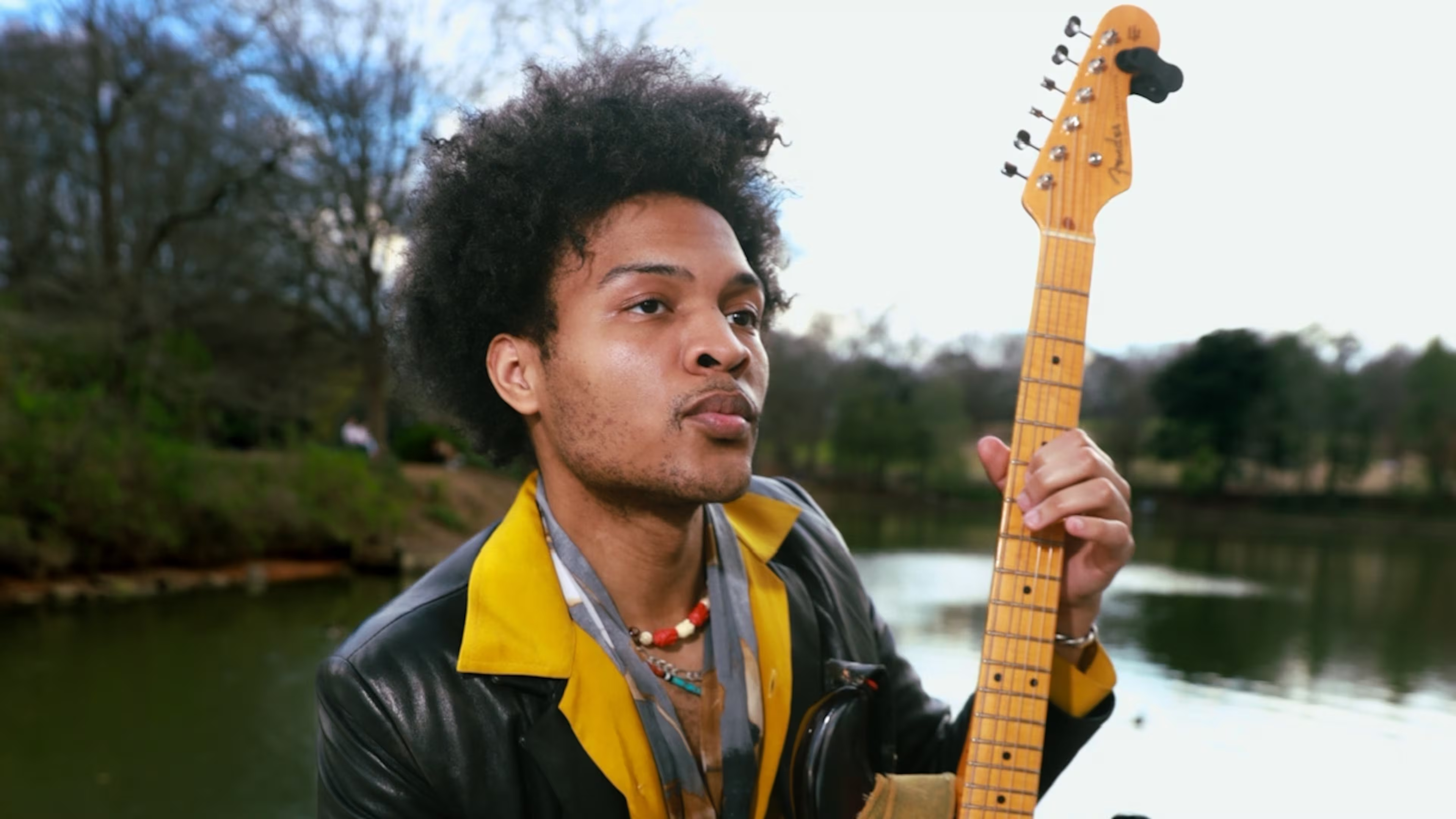
Memorial Day weekend in Piedmont Park has its own sound. Before the crowds fully settle onto blankets and folding chairs, before coolers crack open and the Midtown skyline glows pink against the evening light, the music begins drifting through the trees. Horn lines rise over 10th Street traffic. Drums echo against glass towers. Jazz bends into funk, soul into gospel, blues into improvisation. And this year, one of the loudest and most unexpected voices entering that conversation belongs to Buddy Red.
For many Atlantans, Buddy Red’s appearance at the Atlanta Jazz Festival feels less like a genre crossover and more like a homecoming.
Born Messiah Harris, Buddy Red comes from one of Atlanta’s most recognizable musical dynasties. He is the son of T.I. and the stepson of Tameka “Tiny” Harris, artists whose influence helped define Atlanta’s dominance in hip-hop and R&B over the last two decades. Raised in a household where music was constant — studio sessions, rehearsals, touring conversations, industry veterans moving through rooms — Buddy Red absorbed performance culture early. But instead of following Atlanta’s well-worn rap pipeline, he gravitated somewhere stranger and more solitary: psychedelic rock, Delta blues and guitar-driven soul.
“I guess I realized that I was a little bit different than the rest of my family,” Harris told ArtsATL recently. “Rock and roll or punk or even house music was completely foreign to me at that point. So I knew I had to discover it all for myself.”
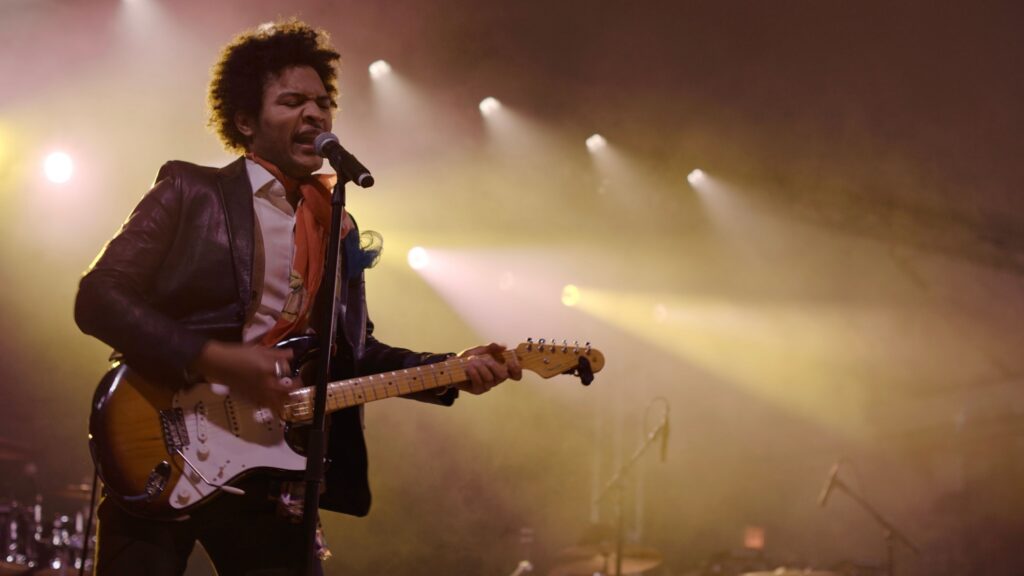
That search eventually led him toward the music of Jimi Hendrix, Pink Floyd, David Bowie and Iggy Pop — artists whose theatricality and improvisational fearlessness now shape his stage presence. His sound combines thick blues riffs, church-rooted vocal phrasing and long exploratory solos that often feel closer to jazz improvisation than conventional rock structures.
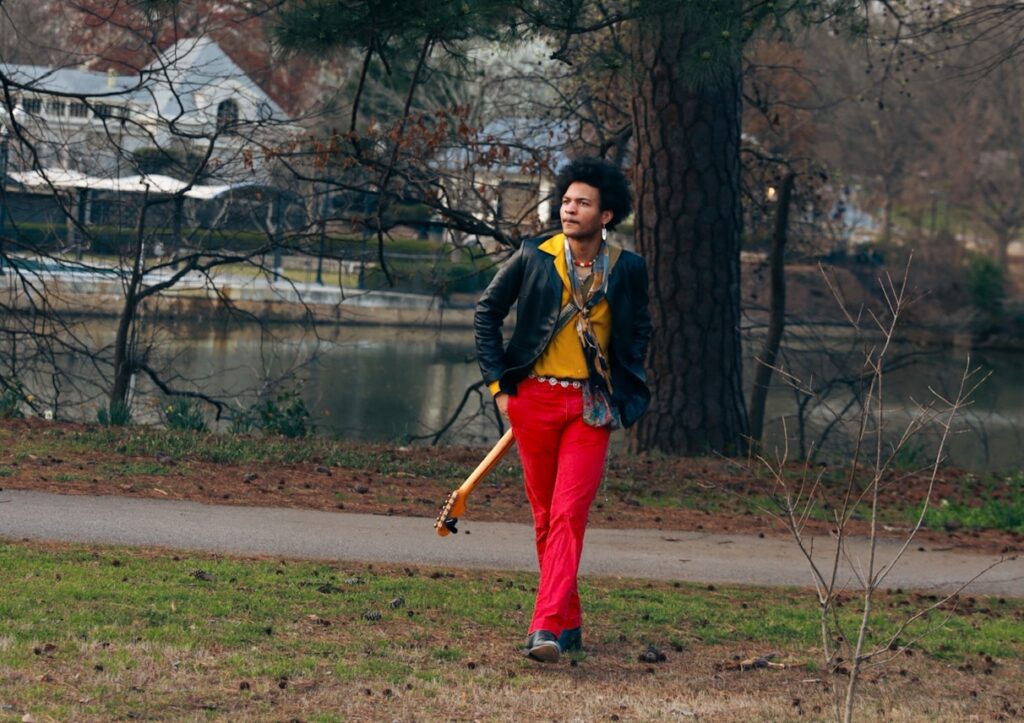
The stage name itself carries family history. In interviews, Harris explained that “Buddy” honors his grandfather on his father’s side, while “Red” comes from an uncle on his mother’s side. “I liked the way Buddy Red seemed to fit me,” he said. “It just felt natural.”
That blend of lineage and reinvention mirrors Atlanta itself.
Atlanta has always been a city where genres collapse into each other. Gospel choirs feed R&B harmonies. Trap producers sample soul records. Jazz musicians drift into funk sessions after midnight. Blues guitarists sit in with hip-hop bands. In Atlanta, scenes overlap because neighborhoods overlap. The city’s musical identity has never depended on purity.
Buddy Red’s career has grown directly out of those intersections.
Long before landing festival stages, he became a regular at the legendary Northside Tavern, one of Atlanta’s most enduring blues rooms. There, amid cigarette haze, neon beer signs and marathon jam sessions, he sharpened his live performance instincts. He also spent time at Smith’s Olde Bar, another foundational Atlanta venue where younger musicians test material, trade solos and build community.
“They do an open mic night every Monday,” Buddy Red said of Smith’s Olde Bar. “I’ve met many great musicians here. There are also great networking opportunities within the music business here.”
Of Northside Tavern, he added: “Northside has a certain charm that is unmatched elsewhere.”
Those rooms matter because they represent a different Atlanta musical tradition than the glossy image often associated with the city. Atlanta’s identity is not only built in arenas and rap studios. It also lives in neighborhood bars, church basements, rehearsal warehouses and late-night jam sessions where musicians from different worlds collide. Buddy Red’s music sounds shaped by all of it.
His blues-rock style also taps into a deeper Southern lineage that predates modern genre labels entirely. Georgia has long produced artists who blurred lines between blues, boogie-woogie, gospel and early rock music, from Piano Red to Speckled Red. Atlanta’s version of blues has always carried movement inside it — swing rhythms, sanctified church cadences and improvisational looseness. Buddy Red’s guitar work, with its elastic phrasing and emotionally stretched bends, feels connected to that tradition even as he filters it through psychedelic rock and modern stage theatrics.
That connection to Atlanta extends beyond sound. Buddy Red has repeatedly framed the city as central to his development, not just geographically but creatively. His performances often feel built around Atlanta’s contrasts: old Southern traditions against rapid urban reinvention, neighborhood intimacy against skyline spectacle.
Few places embody that tension better than Atlanta BeltLine Eastside Trail, where public art, cyclists, musicians and food vendors share space beneath luxury developments and old industrial bridges. The city’s cultural life spills outward there in real time, informal and constantly remixing itself. Buddy Red’s music carries that same energy — rooted in history but resistant to staying still.
His upcoming set at Atlanta Jazz Festival therefore feels significant not because it breaks genre rules, but because it confirms how fluid Atlanta audiences already are.
The festival, held annually in Piedmont Park, has long stretched beyond straight-ahead jazz. Soul acts, Latin ensembles, funk groups and experimental performers have all found homes there over the years. Buddy Red’s inclusion continues that evolution. His guitar-heavy sound may initially surprise traditionalists, but his emphasis on improvisation, emotional spontaneity and live interplay aligns naturally with jazz’s core spirit.
“I look forward to the opportunity to be on any stage,” Harris said recently. “The stage is my home for a few minutes, and I know I’m gonna use that time wisely.”
That mentality — valuing live risk over studio perfection — may explain why Atlanta audiences have embraced him so quickly. In a city where performance culture matters deeply, authenticity still travels fast.
At festivals like this, discovery becomes part of the experience. A listener may arrive expecting traditional jazz and leave obsessed with a blues-rock guitarist they had never heard before. That possibility has always been central to Atlanta’s music culture. The city rewards collision.
And Buddy Red himself embodies another Atlanta story increasingly visible in recent years: younger Black artists reclaiming space in rock, blues and alternative music traditions from which the industry often excluded them. Artists across genres are challenging assumptions about what Southern Black musicians are “supposed” to sound like. Buddy Red’s career exists squarely inside that shift.
“People may compare me to Pops,” he said, referring to T.I.. “But my music is mine and it’s different.”
On the lawn at Piedmont Park, that difference may become especially clear. Electric guitar behaves differently outdoors. Solos expand. Notes linger longer against open air. As the Midtown skyline flickers on behind the stage and crowds settle deeper into the grass, Buddy Red’s sound will likely blur into the city around him: traffic noise, distant MARTA rumble, conversation, laughter, horns and rhythm all folding together.
Which is to say, for a few Memorial Day weekend hours, Atlanta will sound exactly like itself.