



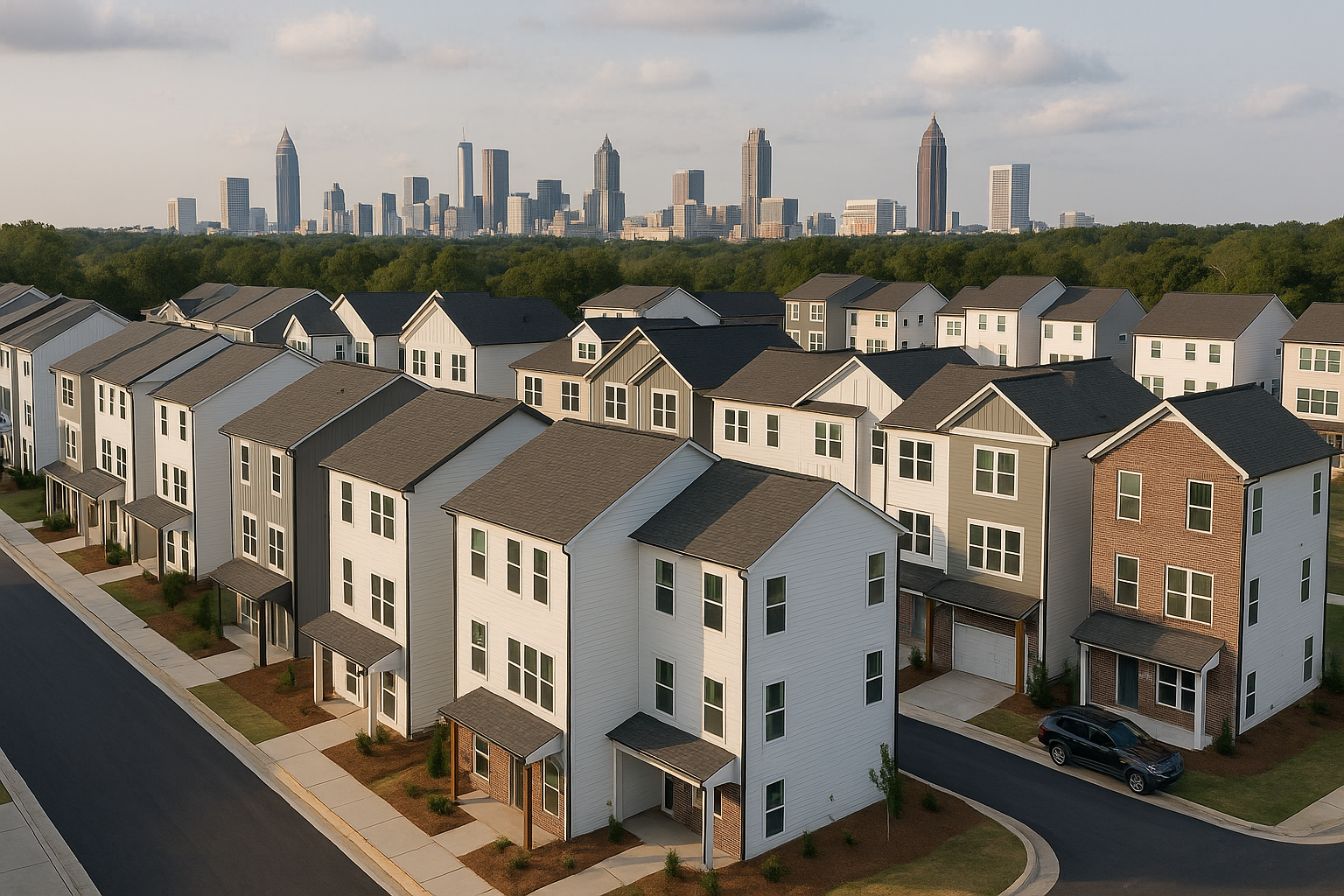
Across Atlanta’s southern and western suburbs, a quieter housing shift is unfolding. Entire neighborhoods of single‑family homes are being built not for sale, but to rent — and the scale of those projects is beginning to shape how growth feels on the ground.
These build‑to‑rent communities are no longer edge cases or experimental projects. They are showing up repeatedly along key corridors south of I‑20 and west of I‑285, becoming part of the everyday suburban landscape and forcing local conversations about infrastructure, affordability and long‑term planning.
What these communities look like in practice
Unlike traditional rental housing, build‑to‑rent developments arrive all at once. Dozens or even hundreds of detached houses are laid out in a single coordinated plan, typically with narrow lots, shallow front yards and consistent designs. Streets tend to be private or lightly marked, with pocket parks, dog areas or small greens rather than large public amenities.
A leasing office or gated entry usually anchors the site. Homes are professionally managed, with maintenance, leasing and rules centralized under one company. The result feels residential, but operates more like a campus than a conventional subdivision.
These projects often land on parcels that sat undeveloped for years or replaced older, low‑density uses. Many are positioned near arterial roads that already feed traffic into existing neighborhoods, which makes access easy — and impacts noticeable.
Who feels the change first
Renters are the most obvious audience. Build‑to‑rent targets people who want space and privacy — extra bedrooms, parking, a fenced yard — without taking on a mortgage or competing in the for‑sale market. For families priced out of ownership, or households not ready to buy, the format fills a real gap.
Homeowners nearby experience a different set of effects. Some see benefits: more activity for nearby businesses, improved roads, or higher property values tied to new investment. Others worry about traffic, repetitive architecture, and the loss of homes that might once have gone to first‑time buyers.
Local governments often feel the pressure before either group. Because these developments deliver population at scale, schools, utilities and road networks can be stressed quickly. Build‑to‑rent doesn’t always fit neatly into zoning categories written for either subdivisions or apartments, which can leave planners playing catch‑up.
Why this trend matters now
South and west metro Atlanta have long absorbed growth differently than the city’s northern arc. Lower land costs and larger parcels make it easier for institutional builders to move quickly, and the rental demand is strong enough to support it.
The larger question isn’t whether build‑to‑rent will continue — it will — but how communities guide it. Decisions made now about density, connectivity, school capacity and infrastructure will shape whether these developments feel integrated or isolated a decade from now.
Over time, widespread rental neighborhoods can subtly change who has access to certain school clusters, how long residents stay in one place, and how civic life forms in areas built without traditional homeownership as the anchor.
What residents can do if one is proposed nearby
These projects often advance quietly until approvals are nearly complete. Staying engaged early makes a difference.
- Watch local planning and zoning agendas for rezoning, subdivision, or site‑plan requests involving large residential parcels.
- Ask specific questions during public meetings: school capacity, road improvements, stormwater management and emergency access are key.
- Request that staff reports include realistic household counts and traffic assumptions — build‑to‑rent occupancy can differ from older models.
- If you’re a renter or buyer, track leasing announcements early. Operators often manage multiple nearby communities with similar rules and pricing.
Build‑to‑rent isn’t inherently good or bad. It’s a tool — and like any tool, outcomes depend on how deliberately it’s used. When neighbors, planners and elected officials engage early, growth can reflect local priorities instead of overriding them.
Build‑to‑rent is reshaping parts of metro Atlanta quietly but decisively. Understanding it now gives communities a chance to influence what comes next.
Indakno — Keeping you in the know.