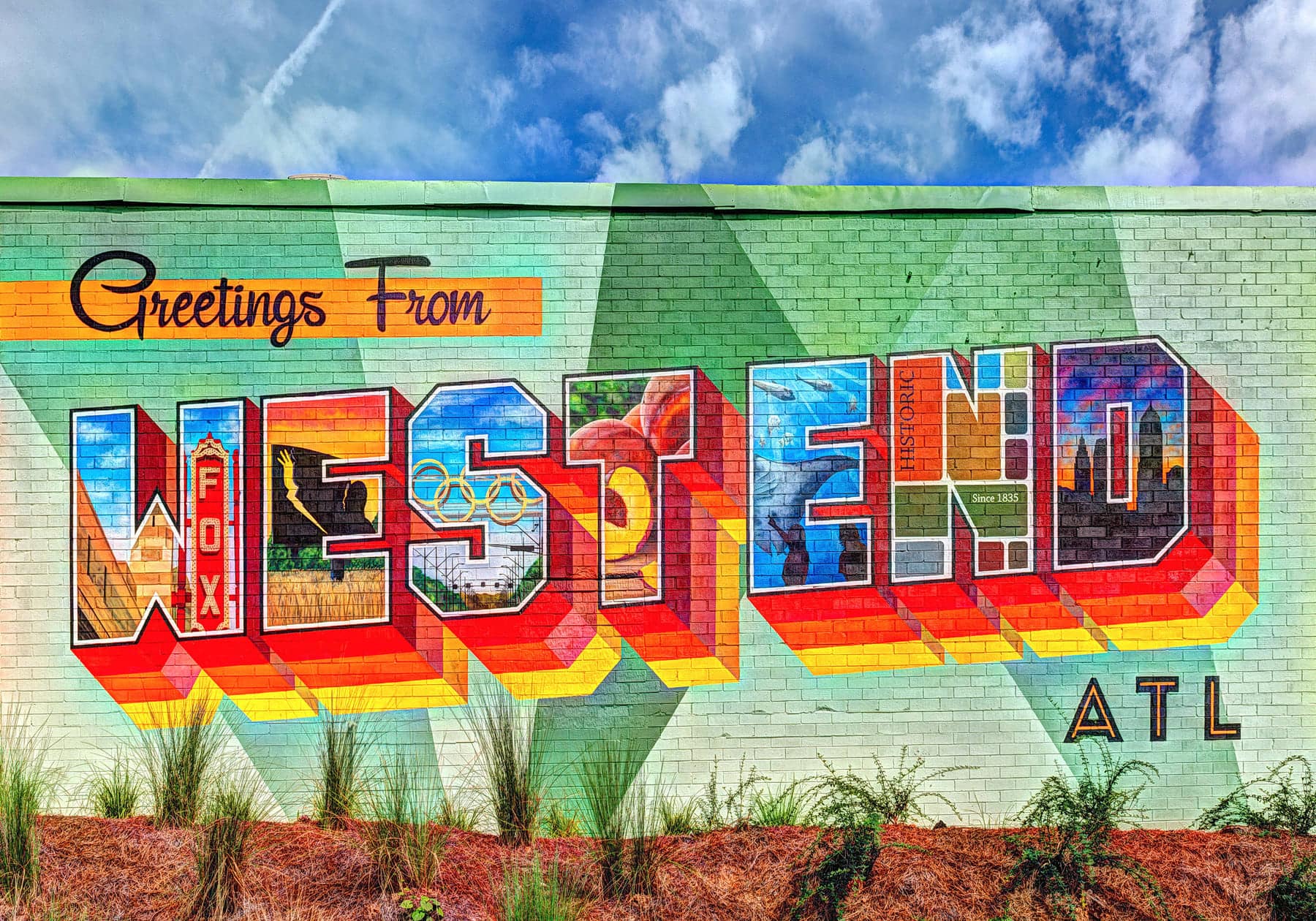
In West End, one of the clearest signs of the neighborhood’s revival is showing up in public view: murals, installations, and community art projects that put local history back on the wall. As restoration and reinvestment continue, that work is giving residents and visitors a more immediate way to read the neighborhood.
That matters in Atlanta, where neighborhoods are often discussed through development long before they are understood through culture. In this southwest Atlanta community, public-facing art is becoming a visible part of how West End’s identity is preserved, interpreted, and carried forward.
History in plain sight
West End’s historic weight is well established, from its architecture to its place in Atlanta’s Black civic and cultural life. But history can turn abstract if it lives only in preservation language or old records. Public art changes that. It places memory where people actually move: along commercial corridors, in gathering spaces, and near transit.
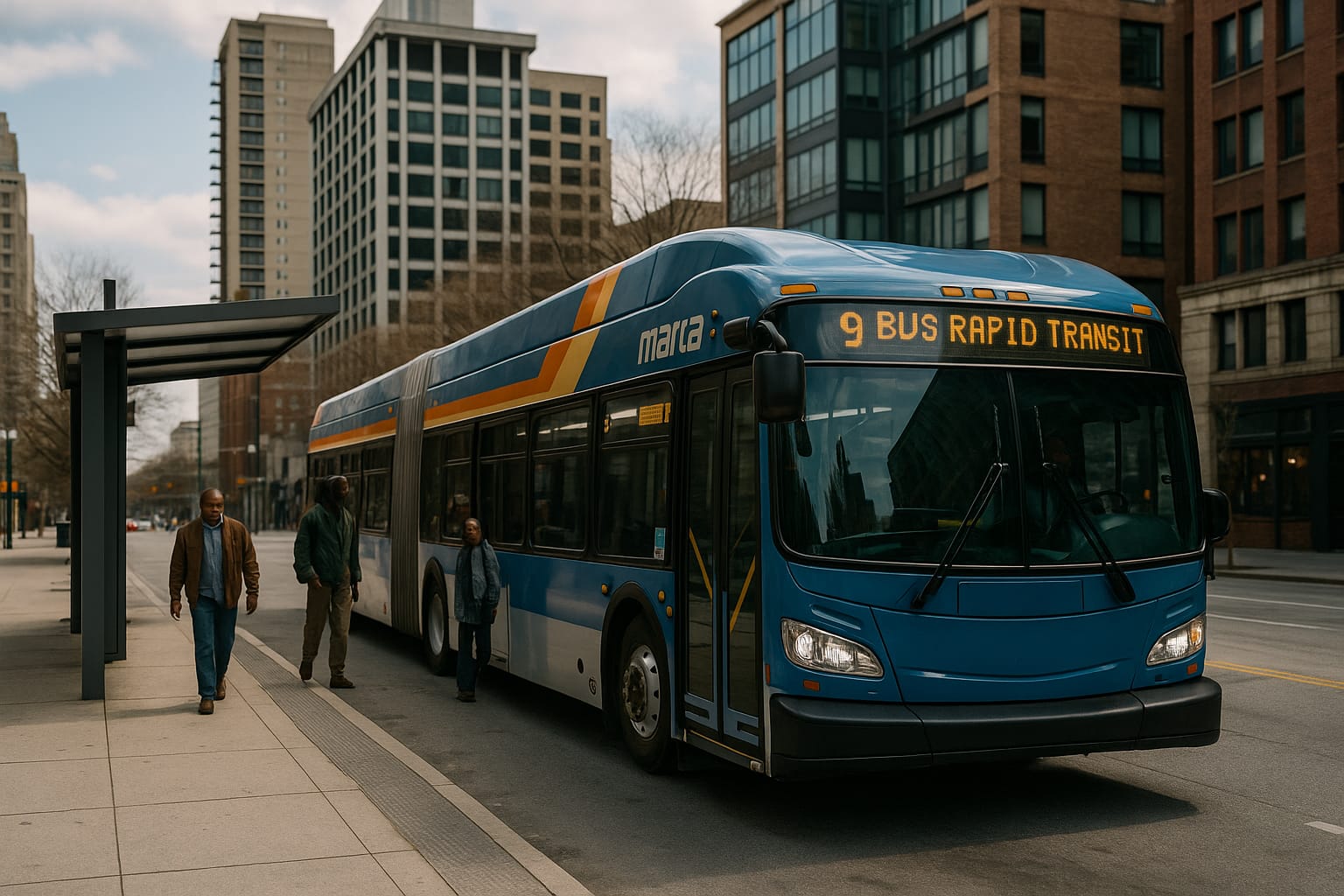
In that setting, murals and installations do more than brighten a wall. They can honor local memory, reflect neighborhood pride, and remind newcomers that West End is not a blank slate. Around the MARTA line and the area’s main corridors, that kind of work helps interpret a built environment that already carries both everyday use and historic character.
Why West End feels especially resonant
The neighborhood’s current cultural energy appears to be shaped less by branding than by stewardship. In a place with churches, schools, block associations, porches, and long civic memory, community-rooted art carries a different kind of credibility. It feels tied to the texture of the neighborhood rather than layered on top of it.
That context matters. West End sits near the Atlanta BeltLine, with the visibility and foot traffic that can bring, while still holding a distinct identity that predates the city’s latest development cycles. It also sits within a part of southwest Atlanta where Black history, public memory, and neighborhood change are not abstract debates. They are lived questions.
So the art reads differently here. Less ornament, more signal. A way of asking how a neighborhood stays legible to itself while it changes.
Beyond aesthetics
Yes, public art can make a corridor feel more cared for and encourage people to slow down. But in West End, it also appears to be doing something deeper: helping residents hold on to continuity during a period of visible change.
That tension is familiar in Atlanta. Historic Black neighborhoods draw new attention, preservation and speculation start sharing the same sentence, and culture becomes both an asset and a point of contest. In that environment, community-led artwork can serve as a form of neighborhood authorship, making clear which stories are remembered and who gets represented in public space.
For readers who know West End mostly from a drive-through, a train stop, or a nearby BeltLine visit, these projects offer a reason to look again. The neighborhood is not discovering culture. It is making culture more visible at a pivotal moment.
What to watch now
The real question is whether that momentum stays resident-centered as West End continues to evolve. With public art, the process matters as much as the finished piece: who commissions it, who participates, whose history is foregrounded, and where the work is placed.
West End’s revival is still unfolding, but its public art already points to something worth watching across Atlanta: change lands differently when a neighborhood can still see itself in the landscape.
Indakno — Keeping you in the know.